
How LLMs Actually Work: What Every SEO Needs to Understand

Written by Raouf Douihech
SEO, GEO/AEO & Marketing Consultant · June 28, 2026
You keep seeing job ads that demand "GEO/AEO skills."
You read that ChatGPT is going to kill SEO.
And somewhere in the back of your mind, there's that nagging doubt: "am I getting left behind?"
Take a breath.
You don't need to be a machine learning engineer to take back control. You need one good mental model. Just one. The kind that lets you explain to a client, a recruiter or your boss how ChatGPT, Claude and AI Overviews actually work, without the hype, and above all lets you know what to do about it on your pages first thing tomorrow morning.
So you know where I'm coming from: I run SEO at scale across about twenty multilingual sites with AI agents (n8n, GPT, Claude). For years my obsession has been keeping a flow of leads that doesn't hang on the next Google update or the latest hype cycle.
In my current role, that has meant seven-figure revenue growth that never flinched, not for a Google update, not for the arrival of ChatGPT, on top of +290% qualified B2B leads. What I'm handing you here is the mental model I wish someone had laid out for me in plain terms.
The short version (for the impatient)
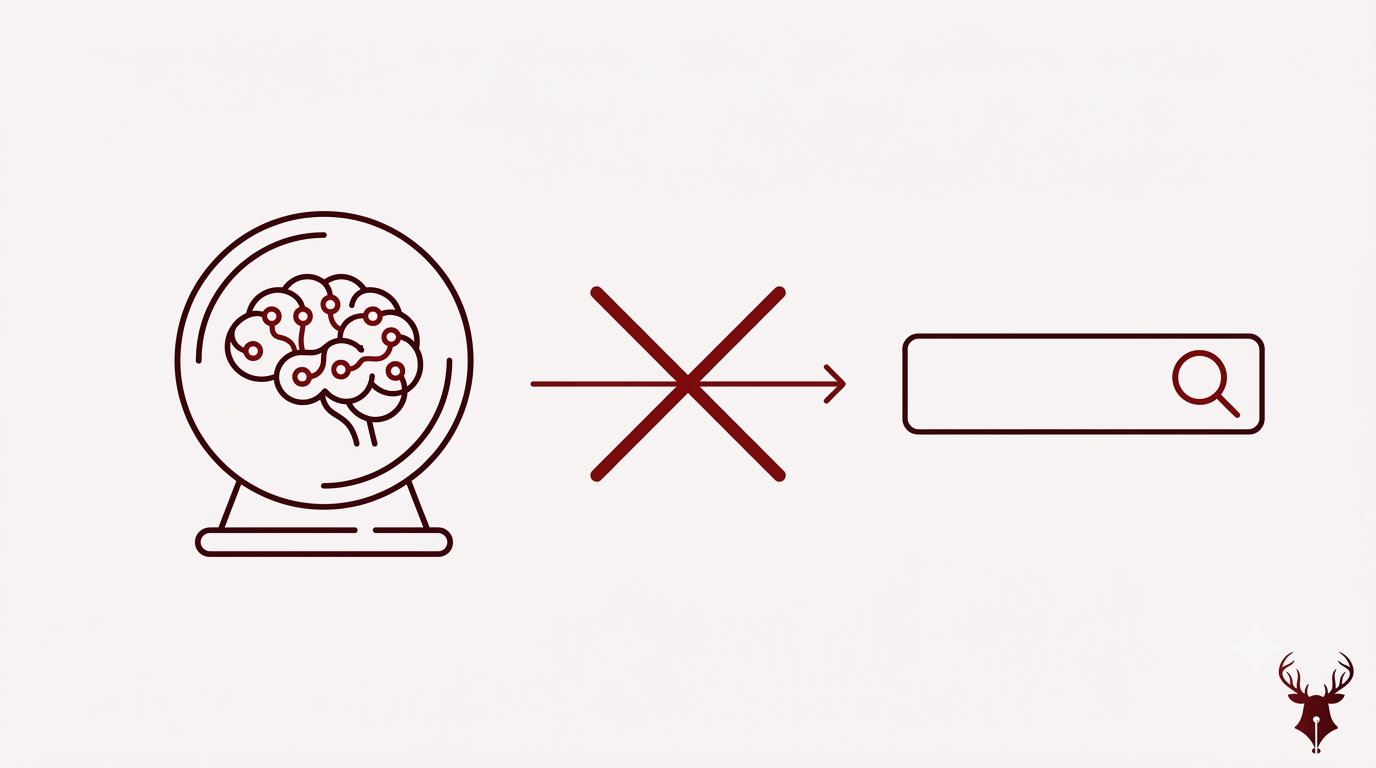
A "bare" LLM (the model) does not search the internet: it predicts text from its training memory.
The systems you actually use (AI Overviews, ChatGPT Search, Perplexity) do go and fetch live sources, then ask the model to write from them.
Your SEO acts almost entirely on the second one. Confuse the two and you're optimizing into the void.
In practice: cover every sub-question of a topic, be clear and unambiguous, stay retrievable by the bots, and get corroborated across several sources.

Here is the distinction that structures everything below, and that almost nobody states clearly:
The model (a "bare" ChatGPT, Claude, Gemini) does not search, it predicts. It answers from memory.
The answer system (AI Overviews, ChatGPT Search, Perplexity) fetches live sources, then asks the model to write from them.
Your SEO acts almost exclusively on the second one.
Keep that picture in mind. Everything else follows from it.
Part 1, the model: how an LLM "thinks"
An LLM is not a search engine
Let's start by burying the confusion that wrecks most "AI SEO" strategies.
A base LLM does not contain the internet and does not search for anything. It's a text predictor. It was fed a gigantic pile of documents, and the only thing it knows how to do is guess the most probable next word after the previous ones. Guess very well, but guess all the same.
When you chat with ChatGPT "on its own," it doesn't look at a single page: it answers from memory, a bit like a brilliant student sitting an oral exam with no books allowed.
Also separate two things people mix up constantly: the model (GPT, Claude, Gemini, the brain) and the product (ChatGPT, the app around it). The product can plug tools onto the model, web search among them. The model alone cannot.
🎯 What this changes for you. As long as you reason like it's a "search engine," you're optimizing the wrong machinery. SEO in the age of AI is two different games: the model on one side, the retrieval system on the other. We'll treat them separately.
Tokenization: AI doesn't read words, it reads chunks
Before it even "understands" anything, the machine slices up your text. Not into words, into tokens: chunks of words, sometimes a whole word, sometimes a syllable, sometimes a punctuation mark.
A common word like "marketing" fits in a single token. A rarer word gets chopped into pieces (think "de / index / ing").
Why? Because working over a few tens of thousands of reusable chunks is far more efficient than over every word of every language. It's plumbing, but it has a consequence for you.
🎯 What this changes for you. The AI does not "see" your exact keywords the way you see them. The keyword copy-pasted ten times tells it nothing. What counts is the meaning carried by the whole, not the repetition of a string of characters.
Embeddings: how the machine "understands" meaning
This is the most useful idea in the whole article, the one that finally makes sense of that famous "topical authority."
Every token, every concept, gets turned into a string of numbers: a vector. Picture a giant map where each word has a position. On that map, "dog" and "puppy" sit almost on top of each other. "Dog" and "democracy" land at opposite ends. The machine doesn't know meaning the way we do, but it knows the distances between meanings. Two close ideas, two close points. That's the machinery behind semantic SEO. Not magic, geometry.
🎯 What this changes for you. Closeness of meaning beats keyword repetition. We moved past keyword stuffing more than a decade ago, and with AI it simply has nothing to do with the game anymore. Maybe by tinkering you'll make stuffing "work" on one isolated test, but it won't hold. What holds is covering a topic's full field of meaning and clearing up the ambiguities. Your job is no longer to repeat a word, it's to occupy a territory.
Attention: why context changes everything
How does the machine know that in "the mouse died," we're talking about a piece of computer hardware and not a rodent? Through the attention mechanism: for each word, the model weighs how much every other word in the context matters for understanding it. That's the "transformers" breakthrough, and it's what unlocked everything.
No need to go deeper into the math. Hold on to the idea: a word's meaning depends on its neighbors, and the model actively computes that weight.
🎯 What this changes for you. A clear, well-structured page, where every entity is named without ambiguity, helps the model weight your content correctly. Vagueness hurts you in the literal, mathematical sense. Clarity isn't a writer's flourish, it's an exploitable signal.

Training vs live search: the "knowledge cutoff"
A model is trained up to a date, then frozen. That date is the knowledge cutoff. Anything that happened after it, the "bare" model has no idea about. Your great article published last week? For the model on its own, it doesn't exist. Ask it for something recent and it will either skip it or make it up.
🎯 What this changes for you. Your recent content is invisible to the memory model. Your only way in is live search, what we call retrieval. And that, precisely, is the ground where your SEO gets all its power back. We're getting there.
Part 2, the system: how AI fetches sources (and cites you, or doesn't)
RAG and grounding: when AI reaches past its memory
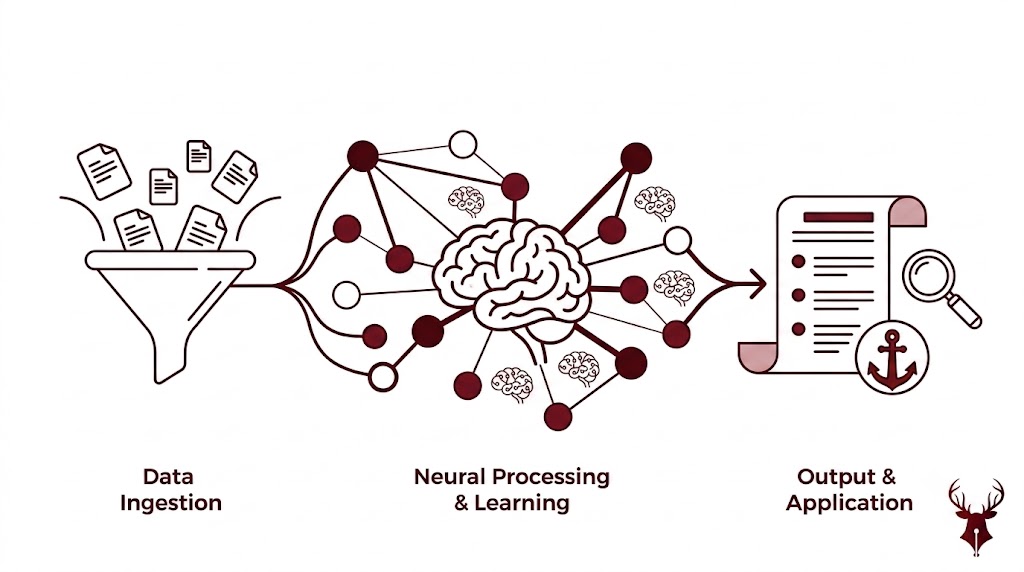
When you ask ChatGPT in search mode, or Perplexity, or you trigger an AI Overview, something other than pure prediction happens. The system rewrites your question, goes and retrieves real documents, ranks them, then asks the model to write the answer from those documents, citing them. That's called RAG (retrieval-augmented generation), and anchoring the answer in real sources is the "grounding."
That is exactly where your SEO still fully exists.
🎯 What this changes for you. You're not optimizing the AI's brain, you're optimizing the retrieval step. Being in the pool of sources the system can fetch is 80% of the battle. The rest is getting picked from that pool.
AI Overviews, ChatGPT, Perplexity, Le Chat: don't lump the beasts together
Here's the mistake I see everywhere: talking about "optimizing for AI" in the singular. There's no such thing. Each system combines a model, a source of knowledge (its memory and/or a specific web index), and its own selection biases. The result: different levers.
And these aren't nuances. Use them daily and you spot it instantly: they don't cite the same sources. An analysis by Profound covering 680 million citations lays bare opposite philosophies: ChatGPT leans on encyclopedic authority (Wikipedia is close to 48% of its primary sources), Perplexity bets on community discussion (Reddit, 46.7% of its primary sources), and Google AI Overviews spreads things out more. More telling still: across that volume, only 11% of domains are cited by both ChatGPT and Perplexity. Two worlds, not one.
Here's the summary map. (The platform-by-platform detail deserves its own guide.)
System | Engine | Where the knowledge comes from | Your main lever |
|---|---|---|---|
Google AI Overviews / AI Mode | Gemini | Live search on Google's index + breaking the query into sub-questions | Solid Google SEO is still the foundation, cover every sub-question |
ChatGPT (Search) | GPT | Memory by default, otherwise grounding via the Bing index | Be indexable in Bing, allow the crawler, sharpen your entities |
Claude | Claude | Web search triggered by the model via Brave Search's index, systematic citations | Being in Brave's index (not just Google and Bing), factual clarity, clean structure |
Perplexity | In-house RAG | Proprietary index + on-demand crawl, strong freshness | Freshness, domain authority, presence on communities |
Le Chat (Mistral) | Mistral | Web search, strong European and French-language bias | Quality French content is structurally favored here |
🎯 What this changes for you. You match the lever to the system, not the other way round. For a French-speaking market, strong French content is over-weighted on Le Chat. For the bulk of traffic across the US, UK and the rest of the EU, it still all rests on healthy Google SEO. "AI" is not one target, it's half a dozen different ones.
Field test: to be cited by Claude, get into Brave's index
A concrete example of this retrieval logic, tested on my own site. Claude's web search runs on Brave Search's index. I asked Claude what it knew about "Raouf Douihech, SEO consultant," with web search on: it cited several sources, but not my site, even though it's well indexed on Google and Bing. The reason was simple: my site just wasn't in Brave's index. And a site that's absent from Brave stays invisible to Claude, no matter how well it ranks on Google.
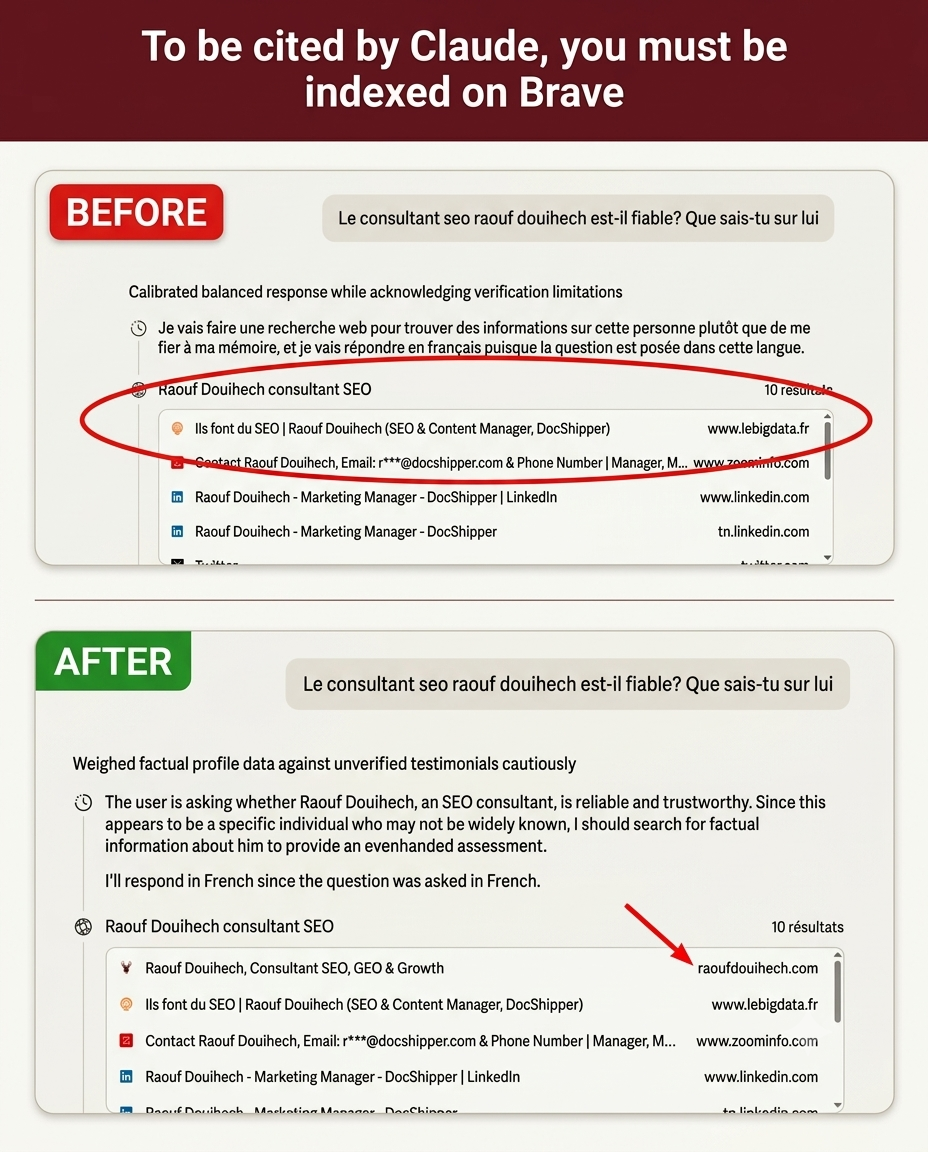
I submitted the site to Brave in the evening. By the next morning, once the homepage was indexed, Claude was surfacing it as the first cited source. The lesson lines up with everything else in this article: being in the right retrieval pool beats Google ranking alone.
To check and fix this on your own pages:
Test your indexing: type site:yourdomain.com on search.brave.com. No results means you're invisible to Claude.
Submit your pages by hand through Brave's submission form: passive indexing is slow, so speed it up.
Turn on the "Web Discovery Project" in the Brave browser settings (address brave://settings/search) to help Brave discover your pages.
🎯 What this changes for you. Don't reduce your AI visibility to Google. Each system has its own pool: Google's index for AI Overviews, Bing for ChatGPT, Brave for Claude. Being indexed where the system actually looks is the entry ticket to getting cited.
Query fan-out: one question, up to ten searches
When you ask a system like AI Mode a question, it doesn't fire one search, it fires several: it splits your question into sub-questions handled in parallel, often around a dozen according to industry analyses.
The consequence on Google's side: your organic SEO is still a foundation, but it's no longer enough. According to Ahrefs, across 1.9 million citations, 76% of pages cited in AI Overviews rank in the top 10 and 86% in the top 100. Other studies put that share much lower and falling, precisely because fan-out goes looking for pages beyond the top 10. If your page only answers the "head" question, you miss the other doors in.
🎯 What this changes for you. Aim for completeness. Not the main keyword alone, but every sub-question a reader (and therefore the AI) asks around the topic. It's the direct application of embeddings and fan-out.

How AI picks who to cite (and what to actually do about it)
Let's be honest: the citation on display isn't always proof of what fed the answer. Academic work shows the source shown up front isn't systematically the one that actually drove the model's reasoning. And these patterns move fast: a Semrush study over more than 230,000 prompts and 100 million citations (July to October 2025) watched ChatGPT's number-one sources reshuffle sharply within a few weeks.
Does that mean you should stop analyzing your citations? No, the opposite. But stop over-reading ONE isolated citation. What pays off is systematic testing: re-run the same queries over several days, across several systems, watch which sites keep reappearing, and go dissect them. That's how you see the real patterns, not by torturing yourself over a single screenshot.
🎯 What this changes for you. Focus on two things you control: being in the retrievable pool, and being corroborated across several independent sources. The rest is reading tea leaves. Test over time, don't theorize from one case.
Part 3, so what do you actually do with this?
The cheat sheet: 5 direct implications for your job
Concept from above | What you do with it |
|---|---|
Cutoff and retrieval | Be indexable in Bing and Brave and let the AI crawlers through, so you exist in ChatGPT Search |
Embeddings and fan-out | Cover every sub-question of the topic, not just the keyword |
Attention and entities | Name and disambiguate your entities, so you get "understood" |
Cutoff | Keep your content up to date, so you exist outside the training set |
Citation mechanics | Get corroborated across several sources, so you get cited |
Exercise (15 min): "see" how AI breaks down a page
Enough theory. Here's an exercise you can repeat on any page, yours or a prospect's.
Create a free API key on Google AI Studio and turn on search (grounding).
Run a page's topic through the API, and pull back the list of generated sub-queries.
Compare: for each expected sub-question, does the page answer it, yes or no?
What you get is the "fan-out gap": the distance between what the AI expects from the topic and what the page actually covers. (I've made the script I use available, you just paste your API key and a URL.)
Let's take a concrete case, and one outside my own field so it lands. Imagine you're helping a heat pump installer. Their page targets the topic "air-source heat pump." When I run that topic through the API, Gemini doesn't ask one question, it asks six: how it works, the upsides, the downsides, installation cost, expected savings, and the rebates available.
And what does most installers' page say? "We install heat pumps, free quote." It covers, at best, how it works, and misses four of the six entry points.
And not the minor ones: the "downsides" (the AI expects an honest answer nobody dares put on their own page, a golden chance to stand out) and above all the "rebates," which are the number-one buying criterion and are almost always missing.
The reflex holds for every topic: a page's title and angle dictate what the AI thinks it covers, therefore the sub-questions it should answer, therefore who it's up against.
🎯 What this changes for you. You've just turned a fuzzy hunch ("you have to cover the topic") into a measurable deliverable: "here are the six questions Google expects on your topic, your page covers two, here are the four sections to add." That's exactly the kind of concrete audit that opens a sales conversation, far more than "we're going to do some GEO."
What Google really says, and the myths to bury
You'll get sold a lot of "AI-special" pixie dust. Sort it out.
First myth to bury: llms.txt as a "ranking factor." Google has been clear, it doesn't use it. My practitioner's stance is simple: I'll believe in llms.txt the day I see a single log line of an AI agent coming to read it on my server.
I've put one on my own site to test. The day a bot actually visits it, I roll it out to my clients. Not before. You don't deploy to a client on the strength of a LinkedIn thread, you deploy on logs.
For the rest, Google's official docs repeat it: no magic file, no secret markup reserved for AI. SEO fundamentals still hold. Useful, first-hand content, on a technically healthy site, that covers the sub-questions.
🎯 What this changes for you. Be wary of the "AI hacks" sellers. The foundation is still healthy technical and editorial SEO, executed with rigor. The day a real change shifts that, it will leave traces in your logs and your data. Not in a viral post.
Where to start leveling up
If you're starting out, here's some against-the-grain good news: a junior sometimes starts with an edge over a senior. Why? Because plenty of experienced profiles are dug into classic SEO and rigid in the face of change. You can learn the new mechanics (GEO, AEO) from the start, without that baggage, and spot faster what works and what doesn't.
While we're at it, let's set the acronyms straight, because the first piece of nonsense that gets to me is hearing that "GEO and AEO don't exist." They do, they're just different mechanics:
SEO, Search Engine Optimization: ranking in the classic results.
AEO, Answer Engine Optimization: being the answer (snippets, AI Overviews).
GEO, Generative Engine Optimization: being cited by the generative engines (ChatGPT, Perplexity, Claude, Gemini).
A simple four-step path: understand the model (you just did), understand retrieval, measure, experiment. For resources, stick to the serious stuff: the videos cited above, the official Google Search Central docs, and a few voices who publish studies rather than hacks.
FAQ
Are AI Overviews and ChatGPT the same thing?
No. AI Overviews are the answer Google shows at the top of its results, powered by Gemini and the Google index. ChatGPT is a product sitting on the GPT model, which mostly answers from memory and only fetches live sources in its search mode. Different index, different biases, different levers.
What is the "knowledge cutoff"?
It's the date a model's training stops. Beyond it, the "bare" model knows nothing of what happened, unless it goes and fetches the information live. That's why your recent content only exists for the AI through live search (retrieval).
Do you need an llms.txt file to be visible in ChatGPT?
Today, nothing proves it helps, and Google has confirmed it doesn't use it. My practitioner's rule: I'll roll it out to my clients the day I see a single log line of an AI agent coming to read it. You decide on logs, not on a viral post.
Is SEO dead now that AI is here?
No. The fundamentals (useful content, a healthy site, coverage of the sub-questions) still hold, AI just adds a layer on top. There will always be rankings and clicks from Google, and a healthy site is also one the AI cites more readily.
GEO, AEO, SEO: what's the difference?
SEO (Search Engine Optimization) aims to rank in the classic results. AEO (Answer Engine Optimization) aims to be the answer (snippets, AI Overviews). GEO (Generative Engine Optimization) aims to be cited by generative engines like ChatGPT, Perplexity or Claude. Three distinct mechanics, one shared foundation of quality.
Conclusion
If you only keep one thing: an LLM on its own predicts from memory, the system around it goes and fetches sources, and your SEO acts on the second. Everything else follows.
Three reflexes to hold on to:
Cover the whole topic, not the keyword alone.
Be clear, dated, and retrievable by the bots.
Get corroborated, and test over time instead of theorizing.
And above all, keep a cool head. The fundamentals aren't dead, they just have an AI layer on top. That's exactly what I put in place for my clients: fan-out audits, multi-platform visibility, citable content. See my SEO & GEO services.